Play
Money
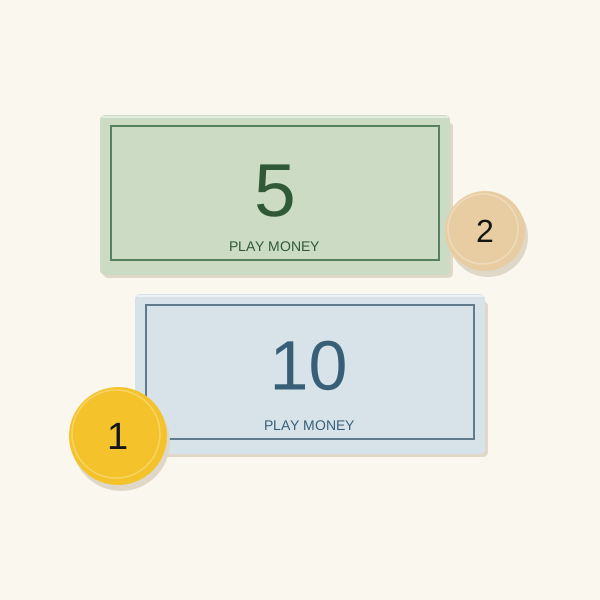
Replica coins and notes for comparing values, making totals, and finding equivalent combinations.
What
they teach.
Simple materials.
Powerful mathematical ideas.
Value and quantity
Distinguish the number of coins from their total value.
Equivalent amounts
Make the same amount with different denominations.
Addition and change
Combine prices or find the difference between payment and cost.
How to use them.
Start with curiosity. Make room for discovery.
Name the currency
Identify each denomination and choose a single currency for the task.
Build an amount
Make a stated total with coins. Explain each coin’s value rather than counting all coins as ones.
Find another way
Replace a coin with an equal-value group of other coins and check the total.
Try an activity
Stock a small shop
Label three household items with simple pretend prices. Choose two, calculate their combined cost, and make an exact payment. Then find a second combination of coins with the same value.
More coins need not mean more money
Five one-cent coins have a lower value than one ten-cent coin. Put both groups on the table and discuss the difference between counting objects and counting their values. The same distinction appears when working with tens and ones in place value.
For U.S. coin tasks, keep cents as the unit at first. A quarter, a dime, and a nickel total forty cents. Once that relationship is clear, connect 40 cents with $0.40; avoid switching notation without explaining the unit.
A pretend shop can support exact payments before introducing change. When change is introduced, count up from the price to the payment and compare that method with subtraction. Use invented prices clearly as task examples, without presenting them as current retail prices.
Choose your toolkit.
Find a format that fits your setting.
Choose the currency learners will use, clear denomination markings, and enough low-value coins for exchanges. Check whether proportions and colors are realistic enough for your purpose.
Physical options link to Amazon. Illustrations show the material, not the exact product.
Physical option · play bills and coins
Learning Resources Pretend & Play Money (150 Pieces)
A US play-money set with 60 paper bills and 90 plastic coins for sorting denominations, making equivalent amounts, and acting out purchases.
View on Amazon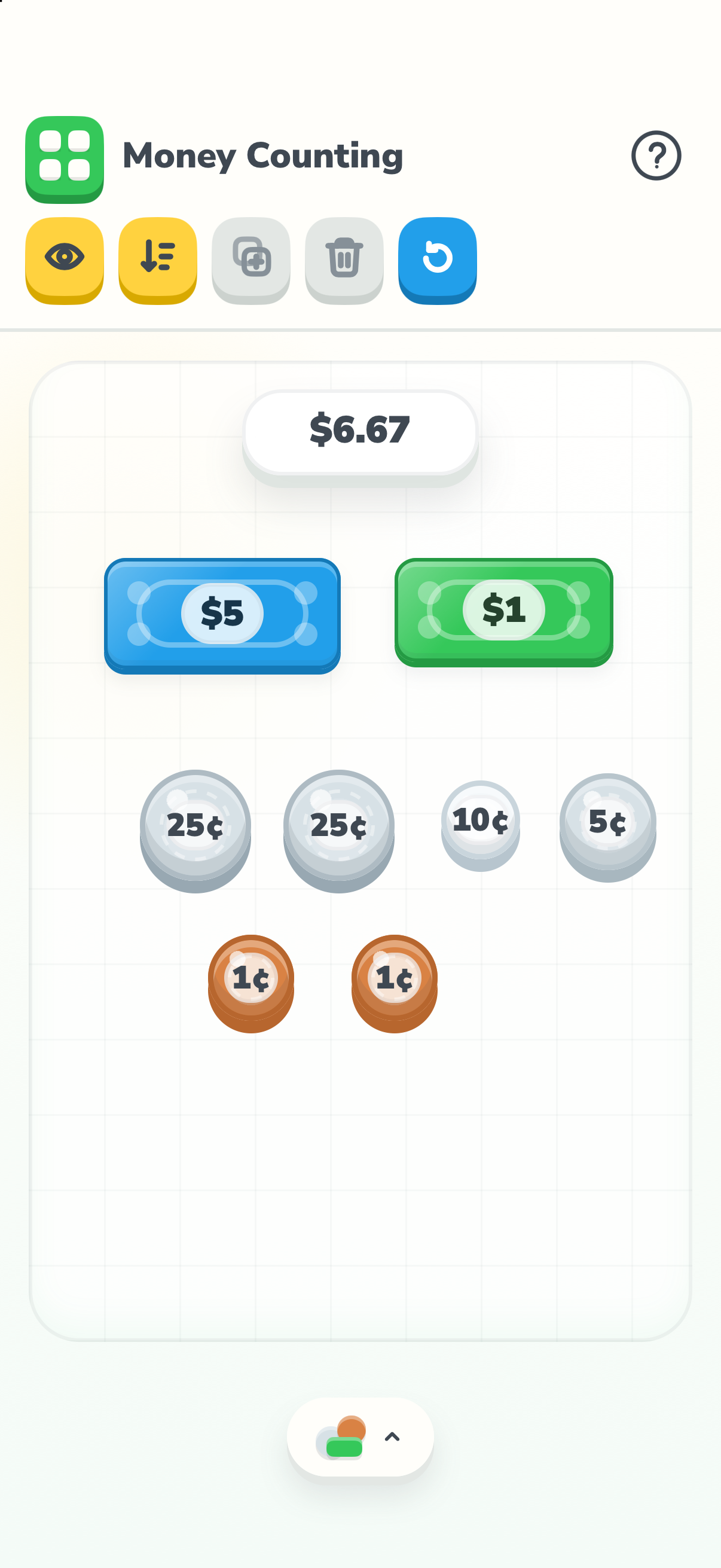
Digital alternative
Manipulatives app
The money preview gives you another way to compare amounts and discuss payments. Check that the coins and bills match the currency used in your activity.
Explore the appSee our editorial and buying policy. Reviewed .
Related tools.
Explore the library →Base-Ten Blocks
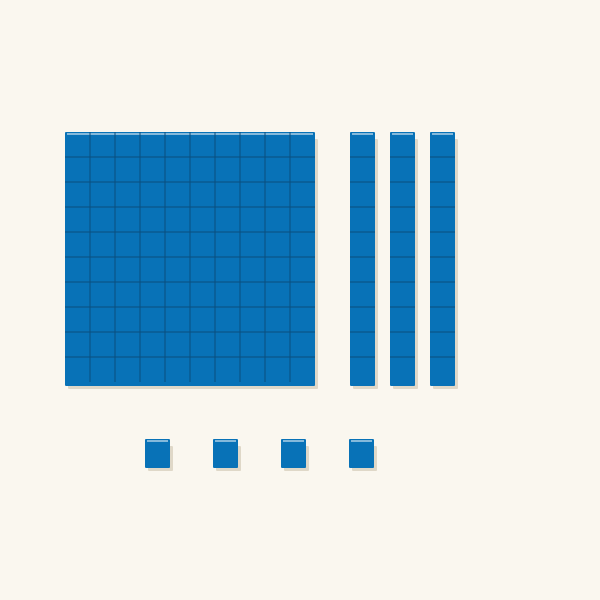
Units, rods, flats, and larger blocks that represent the grouping structure of base-ten numbers.
 Explore
Number Lines
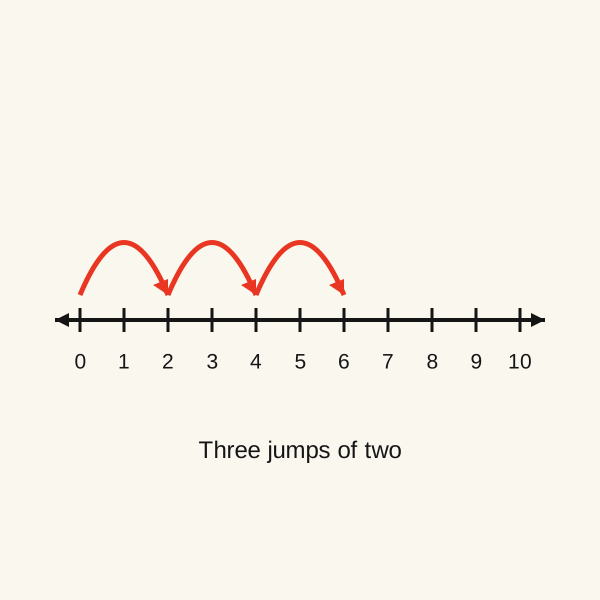
Lines with equal unit spacing for locating numbers, comparing distance, and representing operations.
 Explore
Two-Color Counters
Small disks with contrasting sides for sorting, counting, and representing two parts of a quantity.
 Explore