Base-Ten
Blocks
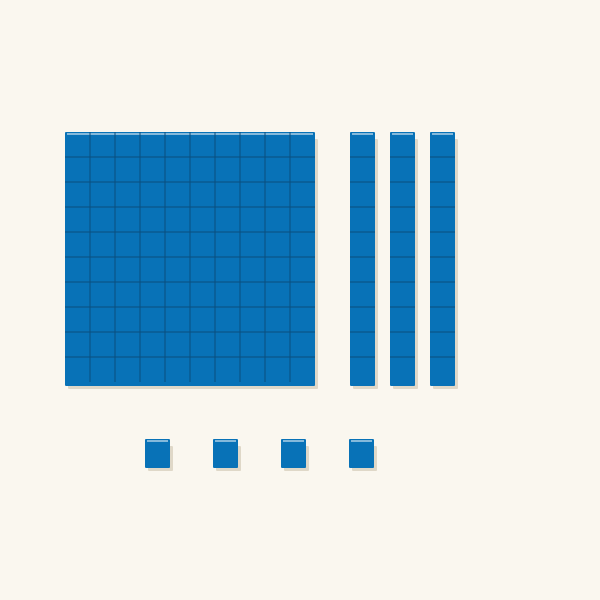
Units, rods, flats, and larger blocks that represent the grouping structure of base-ten numbers.
What
they teach.
Simple materials.
Powerful mathematical ideas.
Place value
Compare one unit, a group of ten units, and a group of one hundred units.
Regrouping
Exchange ten of one piece for one of the next size while preserving the amount.
Operations
Build quantities, join or separate them, and record what the exchanges mean.
How to use them.
Start with curiosity. Make room for discovery.
Agree on the unit
Start with a small cube as one. Line up ten cubes alongside a rod and ten rods alongside a flat.
Build a number
Model 34 using three rods and four cubes. Read the quantity as three tens and four ones.
Trade and explain
Exchange one rod for ten cubes. Describe why two tens and fourteen ones still make 34.
Try an activity
Show 42 three ways
Build 42 using tens and ones. Exchange one ten, then another, to create three representations. Write a matching addition expression for each arrangement.
An exchange changes the pieces, not the value
The key question is not how many objects are on the table. It is how much each object represents. Three rods and four cubes are seven pieces, but they represent 34 when a rod is worth ten and a cube is worth one.
For 27 + 16, build both quantities, combine the ones, then exchange ten of the thirteen ones for a ten. The result is four tens and three ones. Write the equation alongside the model so the physical exchange has a written counterpart.
When using the blocks for decimals, explicitly redefine the unit. If a flat represents one whole, a rod is one tenth and a small cube is one hundredth. Avoid switching between this convention and whole-number values mid-task without naming the change.
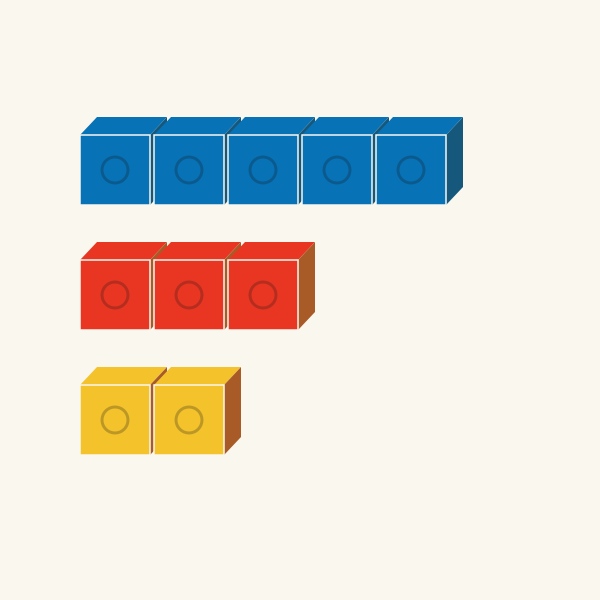
For another way to show grouping, compare a model with linking cubes, which learners can actually connect into tens.
The app preview shows grouping in Math Bars. Its number bars offer a way to work with ones, tens, and groups of a hundred on screen. A physical base-ten set has different pieces and dimensions, so choose the model that makes your lesson’s exchange or measurement visible.
Choose your toolkit.
Find a format that fits your setting.
Choose pieces with consistent ten-to-one proportions. Check the numbers of unit cubes and tens rods, not just whether a large thousand cube is included.
Physical options link to Amazon. Illustrations show the material, not the exact product.
Physical option · plastic
hand2mind Place Value Frame with Base Ten Blocks
Organize ones, tens, and hundreds in separate compartments. Includes a frame, 10 unit cubes, 10 tens rods, 10 hundreds flats, and a Getting Started Guide. Add extra unit pieces for examples such as 27 + 16.
View on AmazonPhysical option · plastic
Simply Magic Base Ten Blocks (131 pieces)
Model place value and regrouping with 100 unit cubes, 20 tens rods, 10 hundreds flats, and one thousand cube.
View on Amazon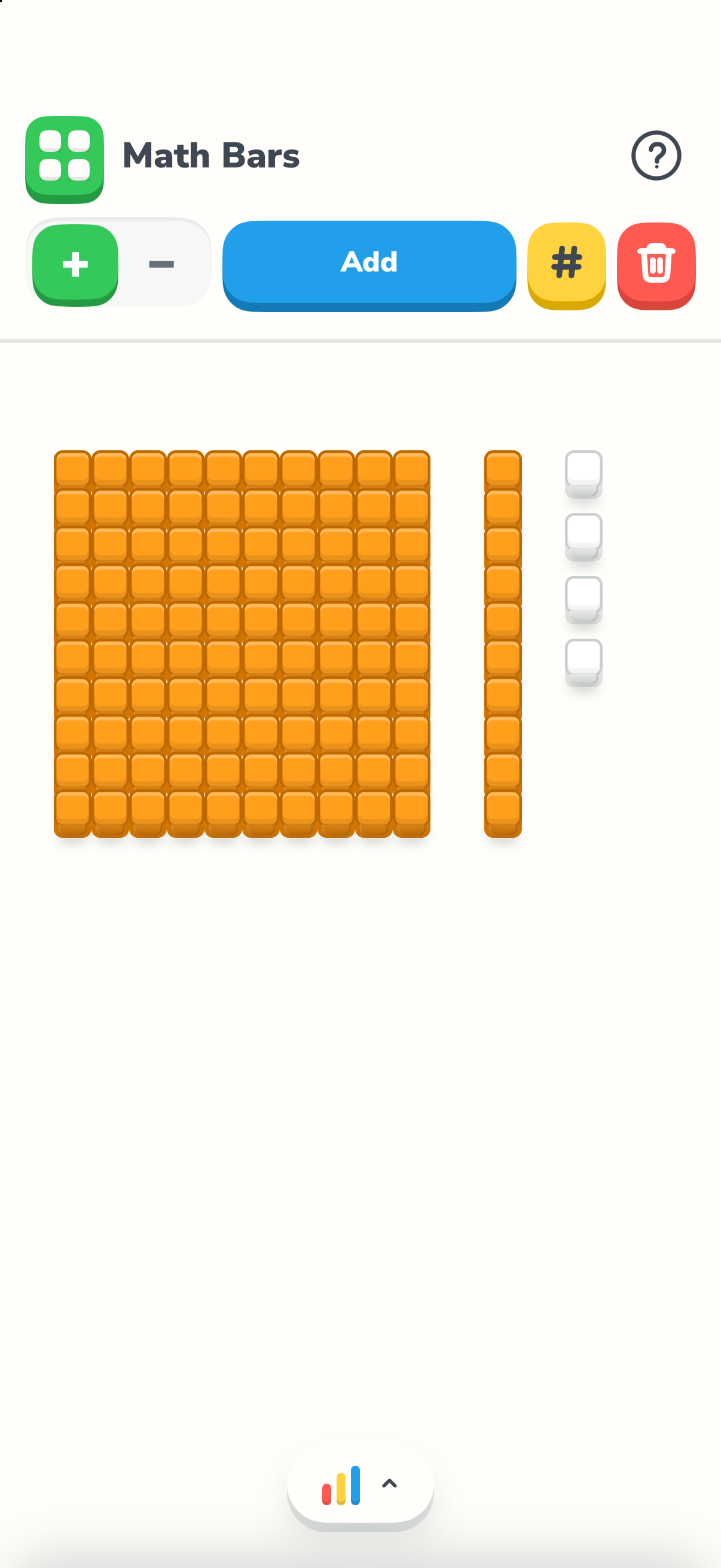
Digital alternative
Manipulatives app
Base-ten grouping in Math Bars
The preview shows tens and ones in Math Bars. This is a grouping model; physical base-ten blocks also let learners compare the lengths, areas, and volumes of their pieces.
Explore the appSee our editorial and buying policy. Reviewed .
Related tools.
Explore the library →Math Bars
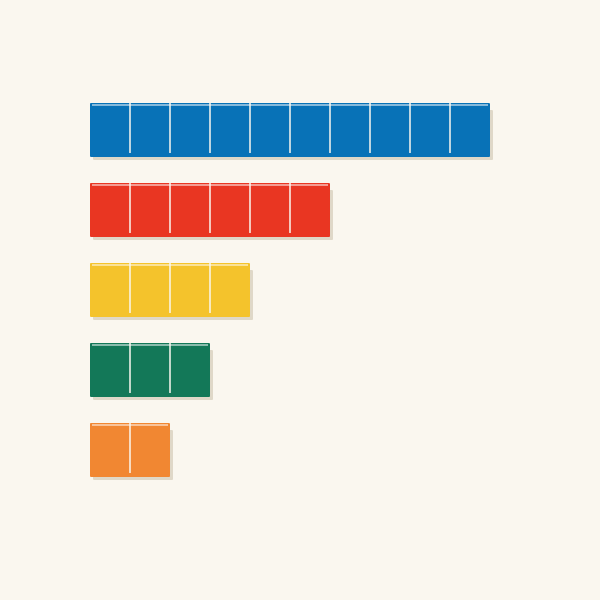
Length-based bars for showing quantities, comparing parts, and drawing attention to numerical relationships.
 Explore
Cuisenaire Rods
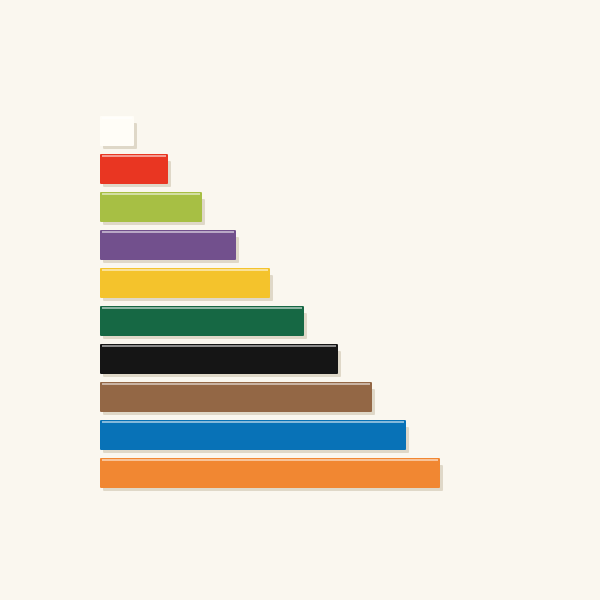
Colored rods with lengths in a one-to-ten relationship for comparing numbers, operations, and fractions.
 Explore
Linking Cubes
Equal-sized cubes that connect into trains, groups, arrays, and three-dimensional builds.
 Explore