Math
Bars
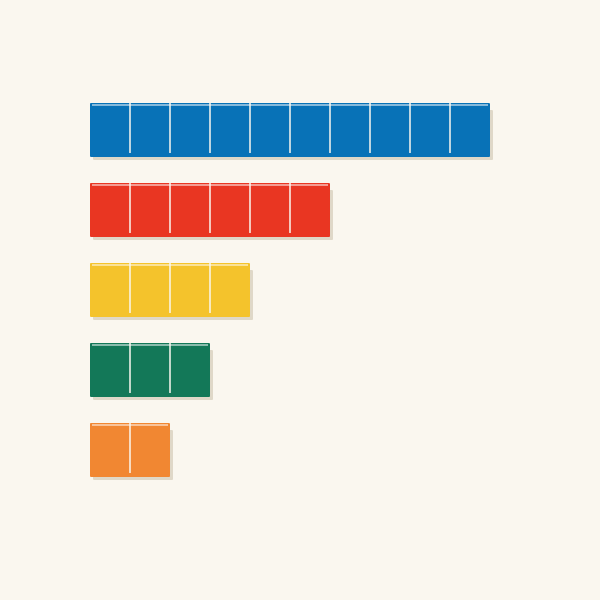
Length-based bars for showing quantities, comparing parts, and drawing attention to numerical relationships.
What
they teach.
Simple materials.
Powerful mathematical ideas.
Part-whole relationships
Show a total as a bar and its parts as shorter aligned bars.
Comparison
Use equal starting points to represent a difference between quantities.
Unknown quantities
Mark a missing length and reason about its relationship to known parts.
How to use them.
Start with curiosity. Make room for discovery.
Define the units
Explain whether bar length is fixed by a scale or is a schematic representation with labels.
Build the relationship
Place parts end to end beneath a whole, or align two totals to compare them.
Connect to an equation
Label known values and use a question mark for the unknown. Explain how the bars support a calculation.
Try an activity
Find the missing part
Make a whole bar worth 18 and show one part worth 7. Represent the remaining part, then explain why 7 + ? = 18 and 18 − 7 = ? describe the same relationship.
Be clear about what “math bars” means
The name covers more than one kind of resource. Fixed-length number bars can act as measurable pieces. A drawn bar model may instead show a relationship schematically, with labels carrying the exact values. Do not assume that two products, or a physical set and an app, use the same conventions.
For a comparison problem, align the beginning of two bars. If one represents 15 and the other 9, the unmatched part represents a difference of 6. For a part-whole problem, place the parts end to end instead. Those arrangements answer different questions even when the same numbers appear.
A bar is especially useful when it makes a relationship easier to explain. Ask the learner to identify the whole, the known parts, and the unknown before selecting an operation. A decorative rectangle drawn after an answer does less explanatory work than a model built while thinking through the situation.
For the fixed-length approach, explore Cuisenaire rods. For grouping ones, tens, and hundreds, use the separate base-ten blocks guide. Math Bars in the app connects these ideas with number bars; physical base-ten cubes and flats also make area and three-dimensional size available to explore.
Choose your toolkit.
Find a format that fits your setting.
Choose bars with a clear unit scale if exact length comparison matters. Check whether the product is a set of fixed lengths, a segmented strip, or a blank bar-model resource.
Physical options link to Amazon. Illustrations show the material, not the exact product.
Physical option · plastic
Thames & Kosmos Kids First Math: Number Rods (250 rods)
Explore counting, measuring, patterns, and operations with 250 colorful rods of varying lengths, guided activity cards, and a stackable storage case.
View on Amazon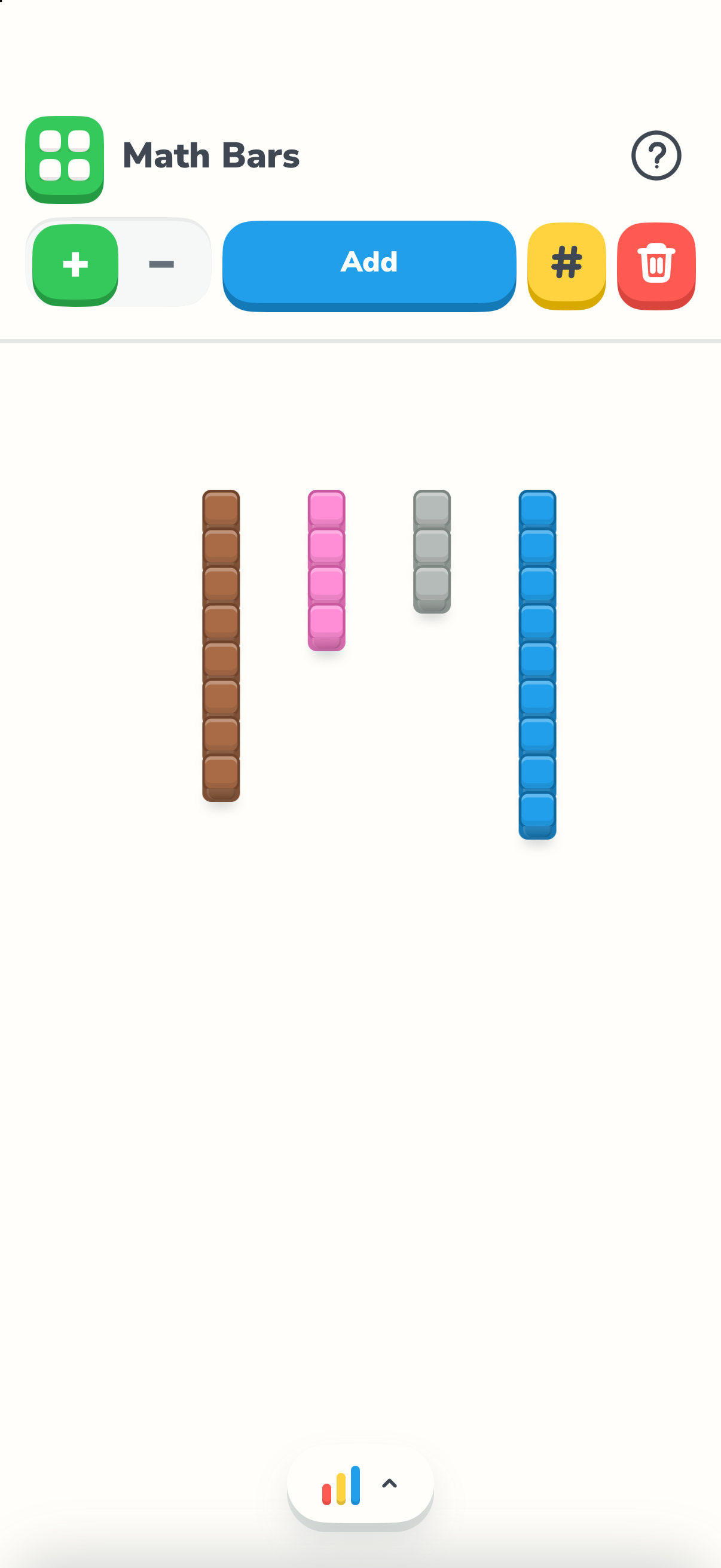
Digital alternative
Manipulatives app
Use Math Bars to show parts of a whole or compare lengths. Name what each bar represents, then connect the arrangement to an equation or an explanation.
Explore the appSee our editorial and buying policy. Reviewed .
Related tools.
Explore the library →Cuisenaire Rods
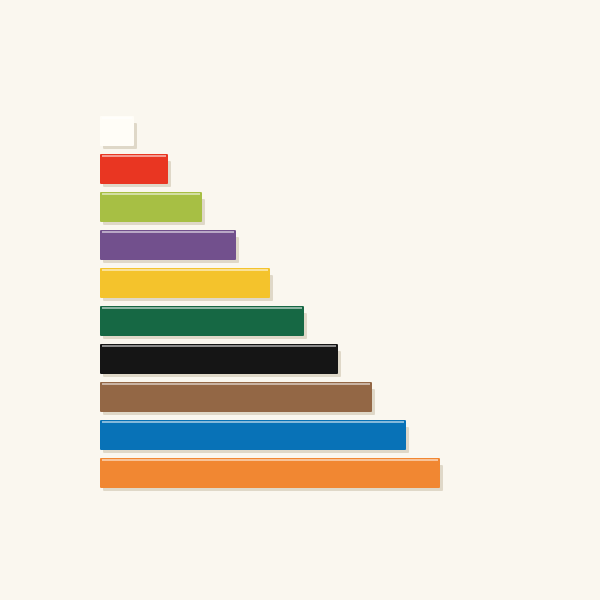
Colored rods with lengths in a one-to-ten relationship for comparing numbers, operations, and fractions.
 Explore
Base-Ten Blocks
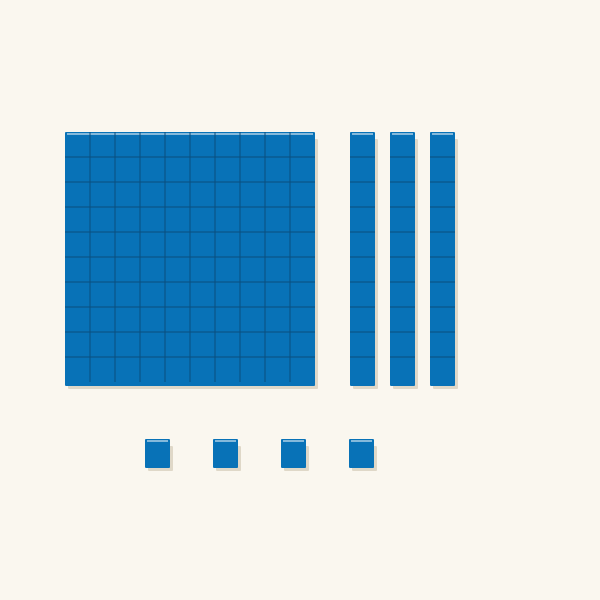
Units, rods, flats, and larger blocks that represent the grouping structure of base-ten numbers.
 Explore
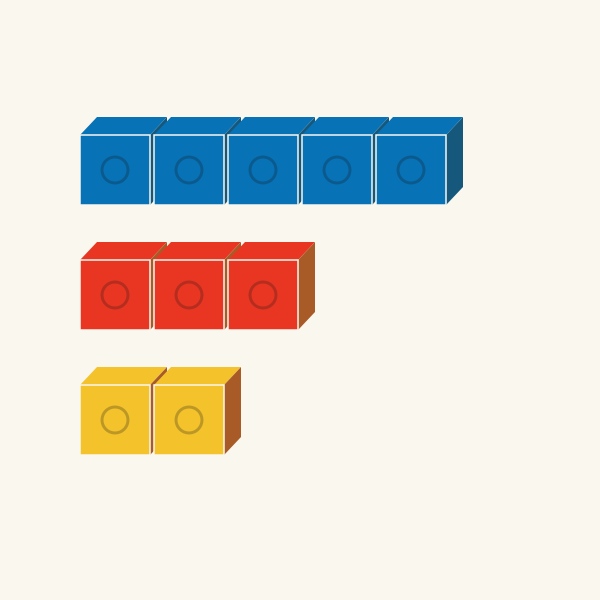
Linking Cubes
Equal-sized cubes that connect into trains, groups, arrays, and three-dimensional builds.
 Explore