Sketch
Pad
An open drawing space for turning a math idea into a picture, revising it, and explaining your thinking.
What
they teach.
Simple materials.
Powerful mathematical ideas.
Visual models
Represent quantities, groups, or shapes with marks whose meaning you can explain.
Connections
Match a drawing to a situation and an equation, identifying what each part represents.
Reasoning and revision
Change a model when it does not fit the question, then explain why the new version works.
How to use them.
Start with curiosity. Make room for discovery.
Choose a question
Start with a small situation, such as four plates with three crackers on each. Decide what one mark will represent.
Draw a useful model
Draw four groups of three marks. Keep the groups visible so someone else can see how the quantity is organized.
Explain and revise
Describe the drawing and write a matching expression. Rearrange the marks into an array and explain why the total stays twelve.
Try an activity
Twelve, two ways
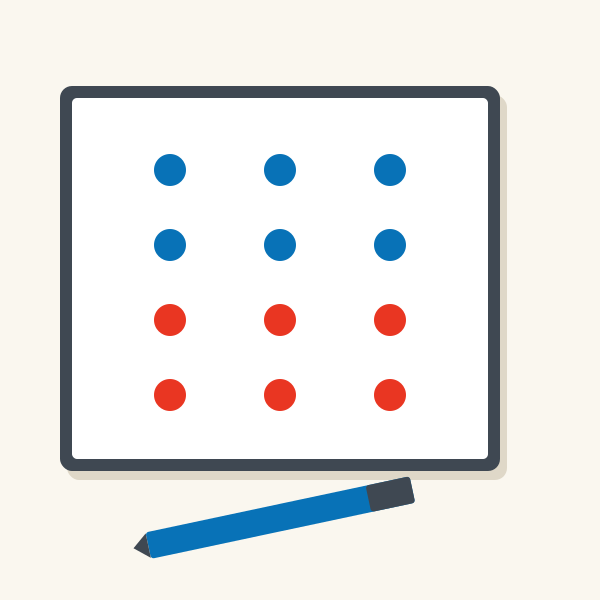
Draw twelve dots as four rows of three. Draw the same total as two rows of six. Compare 4 × 3 and 2 × 6: what changed, and what stayed the same? Use labels or colors to make the groups easy to see.
Draw the relationship you want to see
A sketch pad does not supply a fixed mathematical model. The learner chooses what the marks represent. That makes it useful for moving from a story to a diagram: dots can stand for objects, a line can show distance, and rectangles can show groups or parts of a whole.
Before calculating, ask what each mark means. In a drawing of four groups of three, a group might represent one plate and a dot one cracker. The same twelve dots could represent a different situation, so the explanation matters as much as the picture.
Keep the drawing simple enough to discuss
Use a few clear marks rather than spending the lesson on decoration. Color can distinguish two parts of a total, but labels should make the meaning understandable without relying on color alone. Draw an arrow, circle a group, or add a short note when it helps someone follow the reasoning.
A rough sketch may show a relationship without preserving exact lengths or angles. If a question depends on measurement, use an agreed scale or a more structured tool, such as a number line, math bars, or geometric pieces.
Paper, a small whiteboard, and a digital sketch pad all offer ways to make and revise a model. Keep useful work long enough to discuss it before erasing. The goal is a picture that supports an explanation, not a polished drawing.
Choose your toolkit.
Find a format that fits your setting.
Paper you already have may be enough. Choose pages large enough for a model and explanation, and check which drawing materials suit the paper. The selected option is a four-pack of paper sketch pads. For a reusable alternative, a whiteboard you already own can work. A grid is helpful for arrays, but blank pages support a wider range of drawings.
Physical options link to Amazon. Illustrations show the material, not the exact product.
Physical option · spiral-bound paper sketch pads
Melissa & Doug Mini Sketch Pads (4-Pack)
Four 6 × 9-inch spiral-bound sketch pads with 200 pages total for drawing math models and keeping explanations to revisit. The heavyweight paper suits pencils, crayons, and markers.
View on Amazon
Digital alternative
Manipulatives app
Use the drawing space to sketch a model and explain what its marks represent. Dots, bars, arrows, and short labels are often enough. Paper or a whiteboard can support the same conversation.
Explore the appSee our editorial and buying policy. Reviewed .
Sources and further reading
- Melissa & Doug 6x9 Spiral Bound Mini-Sketch Pad 4-Pack — The selected paper option contains four 6 × 9-inch spiral-bound sketch pads with 200 pages total and heavyweight white paper for drawing.
Related tools.
Explore the library →Math Bars
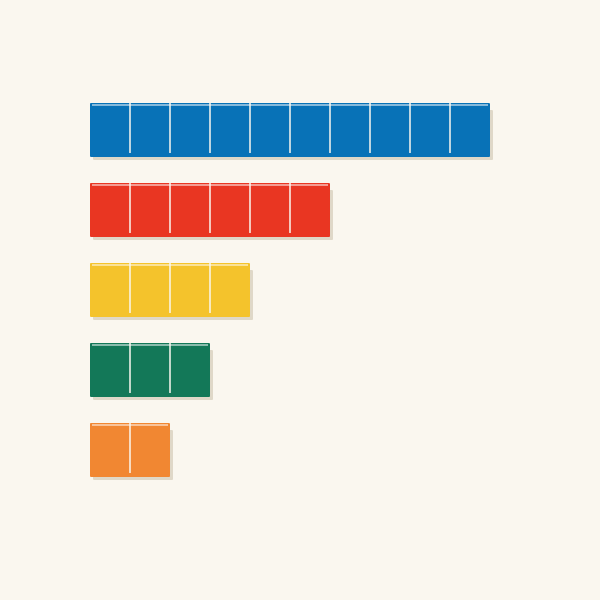
Length-based bars for showing quantities, comparing parts, and drawing attention to numerical relationships.
 Explore
Number Lines
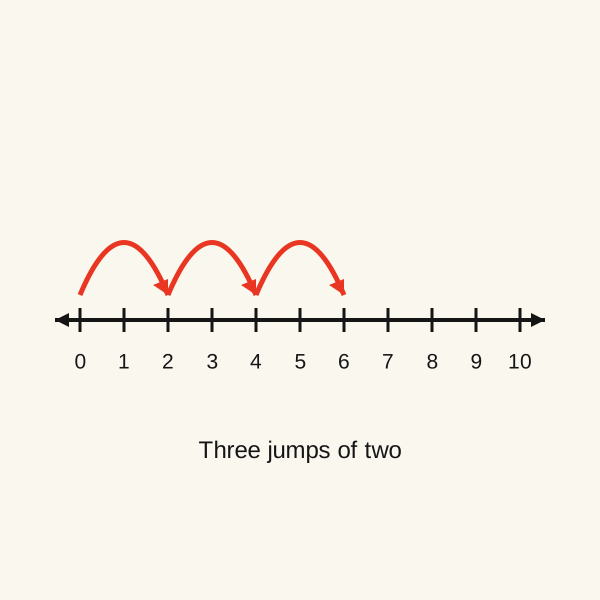
Lines with equal unit spacing for locating numbers, comparing distance, and representing operations.
 Explore
Geometric Shapes
Movable flat shapes for sorting attributes, composing pictures, and explaining how parts fit together.
 Explore