Probability
Spinners
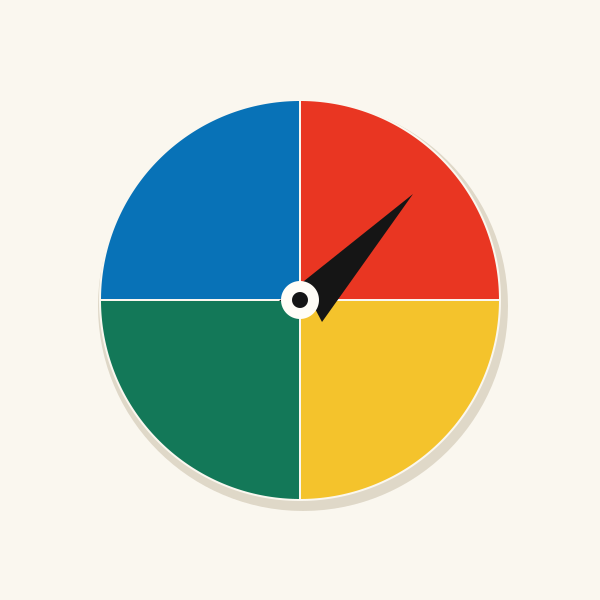
Rotating pointers and marked sectors for exploring possible outcomes and recording chance experiments.
What
they teach.
Simple materials.
Powerful mathematical ideas.
Possible outcomes
Identify the labels that a spin can land on.
Relative likelihood
Compare sector sizes under a stated fair-spinner model.
Experimental data
Record a sequence of spins and compare results with predictions.
How to use them.
Start with curiosity. Make room for discovery.
Read the design
List the labels and compare the angles occupied by their sectors.
Agree on a boundary rule
Decide before starting what to do when the pointer finishes on a line.
Spin and record
Record every result, including repeats, and compare totals after an agreed number of trials.
Try an activity
Two ways to make half
Create one spinner with two equal sectors and another with four equal sectors. Color half of each spinner red. Predict and compare the red results over repeated trials.
Count the share of the circle, not just the labels
A spinner with one red half and two smaller quarters labeled blue and yellow has three color labels. Under an ideal fair-spinner model, red still has probability one half, while each other color has probability one quarter. Equal numbers of labels do not imply equal probabilities.
A real pointer may have friction or a preferred direction. Phrase theoretical predictions as applying to an ideal fair spinner and use observations to discuss how a physical device behaves. A small sample alone cannot establish that a device is fair or unfair.
For repeatable classroom recording, establish the treatment of boundary results before the first trial. Re-spinning every boundary result is one possible rule. Changing the rule after seeing an inconvenient result makes the collection less consistent.
Choose your toolkit.
Find a format that fits your setting.
Look for a pointer that turns freely, clear sector boundaries, and replaceable or blank faces if learners will design their own experiments.
Physical options link to Amazon. Illustrations show the material, not the exact product.
Physical option · dry-erase spinners
hand2mind Assorted Color and Number Spinners, Set of 6
Six assorted color and number spinners for collecting outcomes and playing math games. Their dry-erase surfaces can be labeled and wiped clean for new experiments.
View on Amazon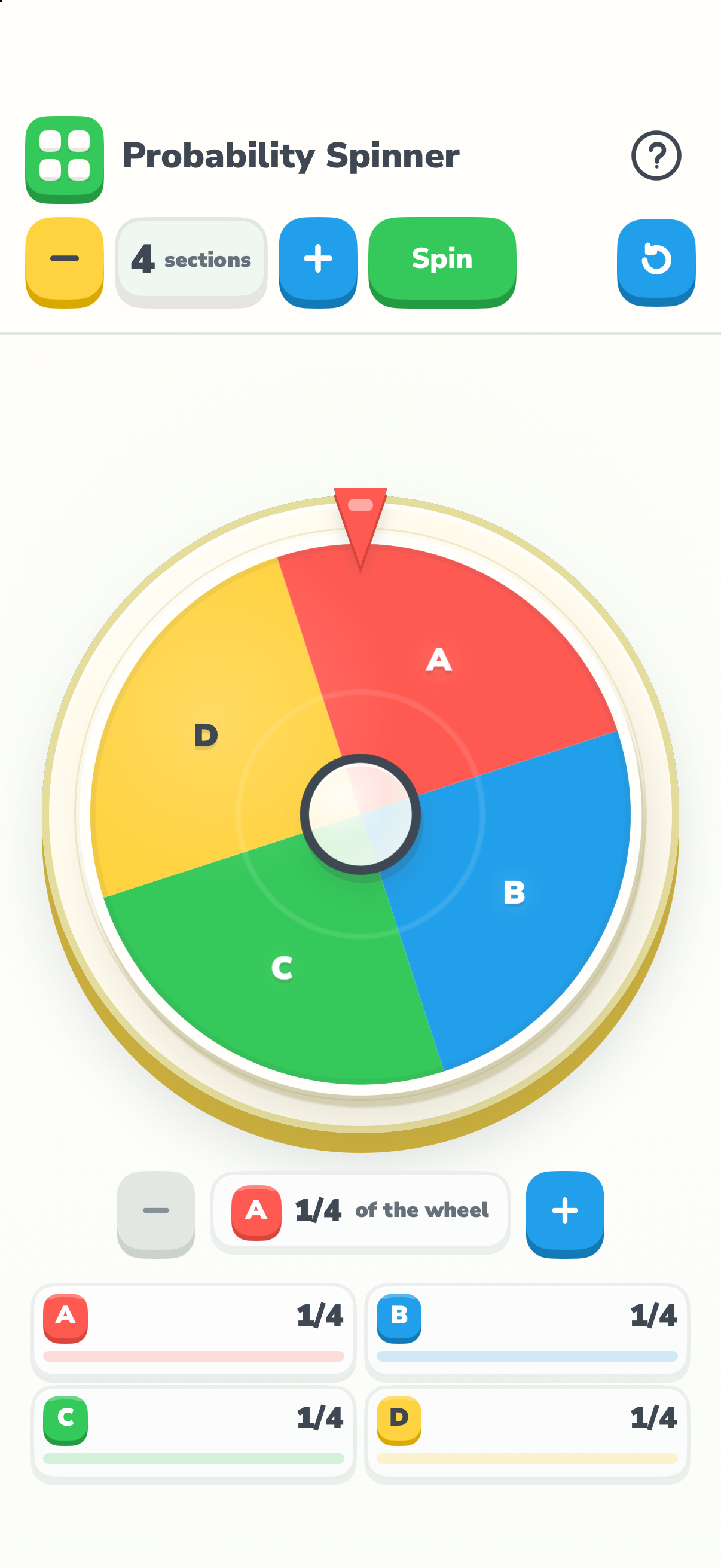
Digital alternative
Manipulatives app
The spinner model gives you a starting point for discussing possible outcomes. Compare the sizes of the sections before making a prediction, then record a sequence of results.
Explore the appSee our editorial and buying policy. Reviewed .
Related tools.
Explore the library →Dice
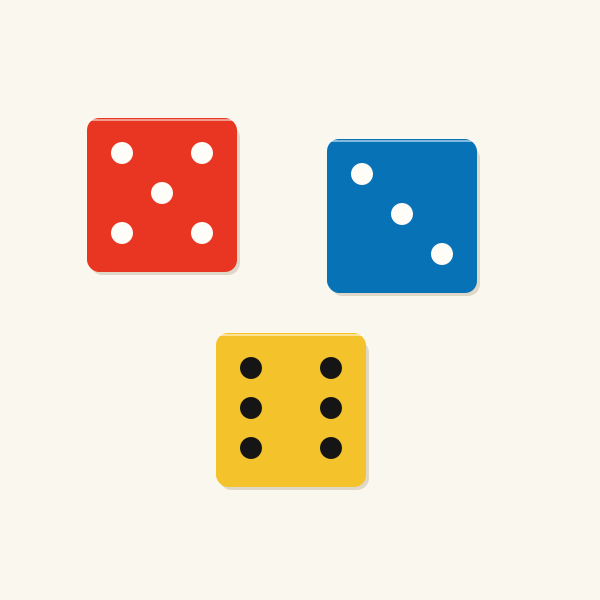
Objects with numbered or dotted faces for generating values, playing number games, and collecting chance data.
 Explore
Fraction Circles
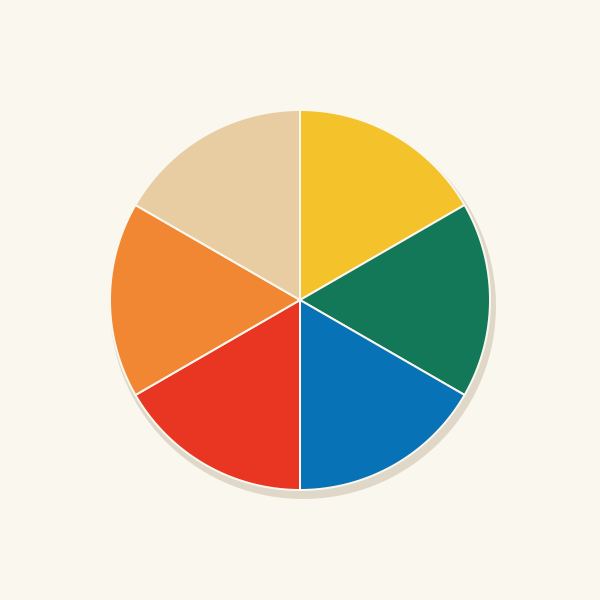
Equal-sized circles divided into equal parts for comparing fractions of the same whole.
 Explore
Hundred Charts
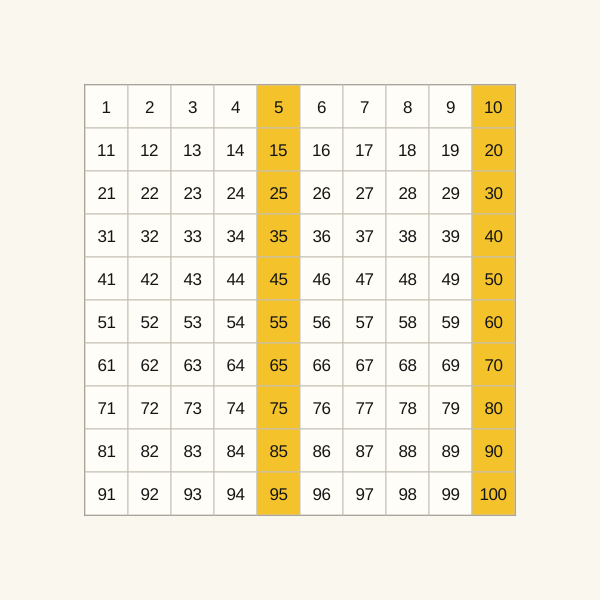
Ten-column number grids for exploring counting sequences and relationships between rows and columns.
 Explore