Hundred
Charts
Ten-column number grids for exploring counting sequences and relationships between rows and columns.
What
they teach.
Simple materials.
Powerful mathematical ideas.
Number sequences
Follow consecutive numbers and repeated increments through the grid.
Tens and ones
Compare vertical changes of ten with horizontal changes of one.
Pattern rules
Describe what stays the same in a column or a highlighted sequence.
How to use them.
Start with curiosity. Make room for discovery.
Check the layout
Notice whether the chart begins at zero or one and how many numbers are in each row.
Trace a sequence
Start at a chosen value and mark every second or fifth number. Describe the resulting pattern.
Explain a move
Choose a number away from the edges, move down one row, and explain why its value increased by ten.
Try an activity
Find a hidden number
Cover one number on a standard 1–100 chart. Use the visible neighbors to work out the missing value. Give two different explanations, then cover a small group of adjacent numbers.
The layout creates the visible pattern
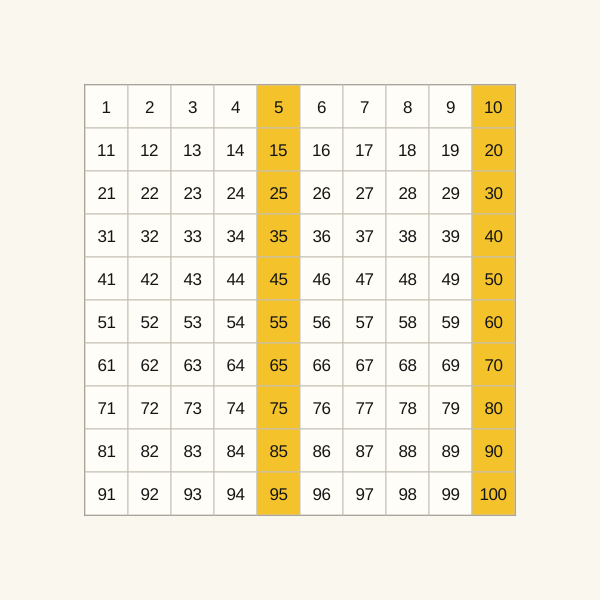
On a conventional 1–100 chart with ten numbers in each row, moving down one row adds ten. That relationship comes from the row length. On a five-column chart, the corresponding change would be five.
Horizontal rules need care at an edge. Nine and ten are beside each other, but ten and eleven wrap to different rows. A chart is a folded arrangement of the counting sequence, so it behaves differently from a straight number line.
Ask learners to predict a marked pattern before filling the whole chart. For counting by fives, which columns will be used? Then test the prediction. A different starting number makes a useful follow-up: starting at two and adding five uses a different pair of columns while preserving the step size.
Choose your toolkit.
Find a format that fits your setting.
Check whether the chart is 1–100 or 0–99 and whether rows run in the expected direction. Wipe-clean surfaces and loose covers are useful for repeated pattern tasks.
Physical options link to Amazon. Illustrations show the material, not the exact product.
Physical option · wooden board and number tiles
Coogam Wooden Hundred Board (1–100)
A wooden board with 100 removable number tiles for ordering numbers, skip counting, and exploring patterns. Includes activity cards, two wooden dice, and a storage bag.
View on Amazon
Digital alternative
Manipulatives app
Use the chart to look for patterns in rows and columns. Ask learners to predict where the next number will fall and explain how the chart’s layout supports their prediction.
Explore the appSee our editorial and buying policy. Reviewed .
Related tools.
Explore the library →Number Lines
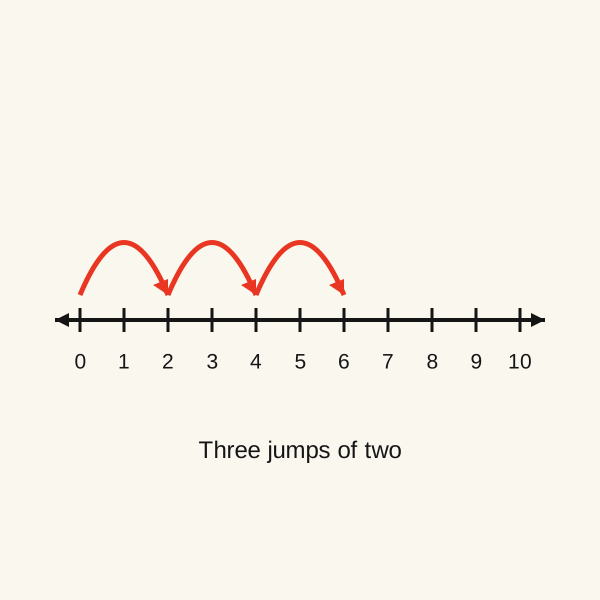
Lines with equal unit spacing for locating numbers, comparing distance, and representing operations.
 Explore
Base-Ten Blocks
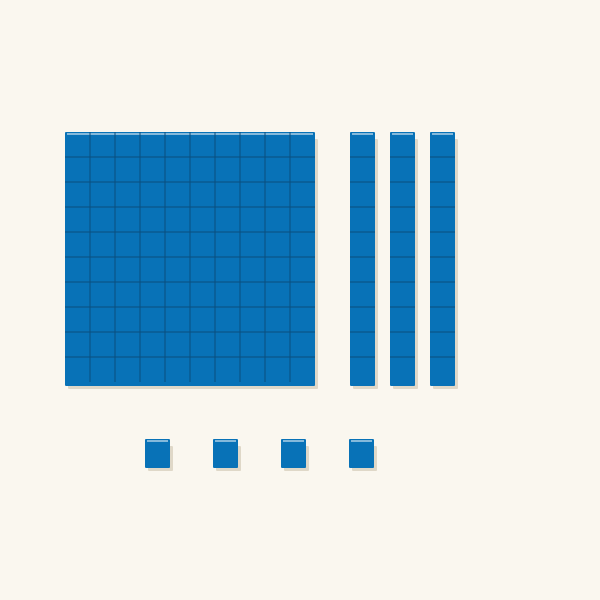
Units, rods, flats, and larger blocks that represent the grouping structure of base-ten numbers.
 Explore
Ten Frames
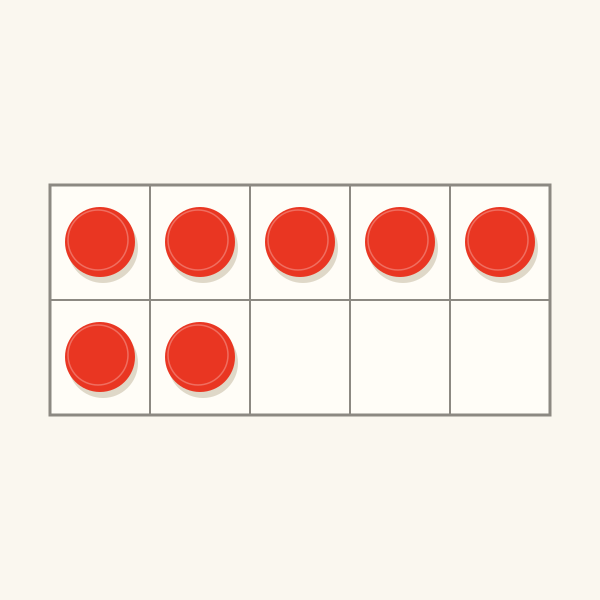
Two rows of five spaces that organize counters around the benchmarks five and ten.
 Explore