A whole new way to see fractions
Use familiar shapes to explore parts, wholes, and equivalent fractions. Start by choosing the whole.
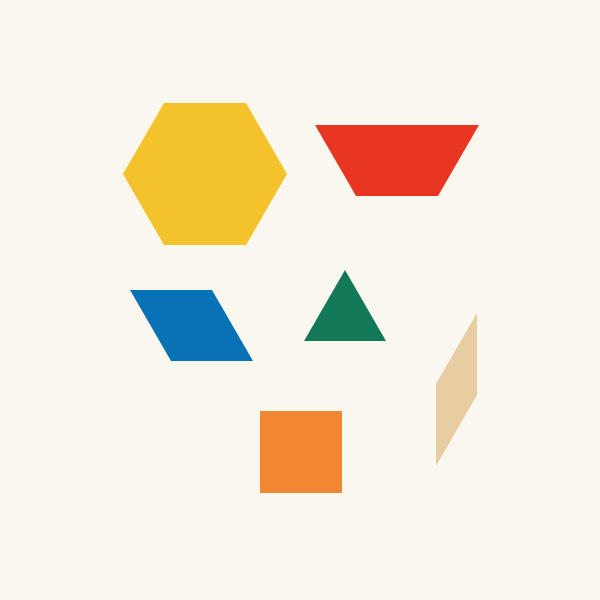
Place a yellow pattern-block hexagon on the table and ask a learner to cover it with smaller pieces. Before introducing symbols, let them discover several ways to fill the same outline without gaps or overlaps. The covering is the evidence you will use when naming the fractions.
For this activity, use standard pattern blocks and make the yellow hexagon one whole. Keep that choice visible throughout the first conversation. Set aside the orange squares and narrow tan rhombuses, which do not belong to the same simple family of hexagon coverings.
Start with the chosen whole
Two red trapezoids cover the hexagon, so each trapezoid represents one half of this whole. Three blue rhombuses cover it, so each is one third. Six green triangles cover it, so each is one sixth. Ask the learner to show these relationships with pieces, rather than simply accepting the color names as a code.
Now cover one trapezoid with triangles. Three triangles cover the same region. You have one object in one model and three objects in the other, but both models represent the same fraction of the hexagon. Write 1/2 = 3/6 beside the arrangement.
The number of pieces and the amount represented are different things. Ask, “What is each small piece worth?” before asking, “How many pieces are there?” That order can make an explanation more precise: three one-sixth pieces make one half.
Give the learner a target
Choose a region to fill, such as two thirds of the hexagon. One solution uses two rhombuses. Another uses four triangles. A trapezoid and a triangle also cover two thirds when arranged appropriately. Put the solutions side by side and check that each covers the same area.
The useful question is not only whether the answer is correct. Ask what exchange connects one solution to another. Replacing a rhombus with two triangles preserves area. Replacing a trapezoid with three triangles does too. These exchanges provide a way to explain the equality without relying on a memorized rule.
If the learner is ready, record 1/2 + 1/6 = 4/6 = 2/3. Let the written expression describe a model already under discussion. If the notation distracts from the idea, return to spoken descriptions and add symbols later.
A mismatched covering can be useful as well. Leave a gap deliberately and ask whether the fraction claim still holds. The task gives a reason to pay attention to the whole region rather than to a count of colored objects.
Change the whole deliberately
After working with one hexagon, place two hexagons together and call the pair one whole. Ask what a single hexagon represents now. It is one half of the new whole, though its physical size has not changed.
The green triangle is now one twelfth of the two-hexagon whole. Count or arrange twelve triangles to check. Do not change the reference whole casually in the middle of an explanation; announce the new choice and keep it visible.
Finish by connecting one result to another model. On a number line, locate one half between zero and one, then divide that same unit into sixths. The third sixth reaches the same point. With fraction tiles, align a half strip with three sixth strips.
The pieces and pictures look different, but the equality survives. Ask the learner to explain that connection in their own words and keep one clear example as a record of the investigation.