Make the exchange visible
Make regrouping visible by building quantities, trading units, and connecting the pieces to written numbers.
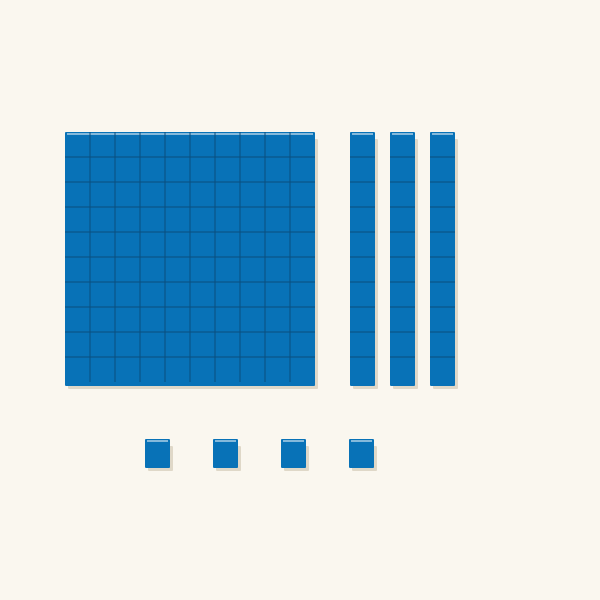
When a written calculation asks a learner to regroup, the marks on the page can hide what is happening to the quantity. Base-ten blocks offer a way to show the exchange: ten ones can be replaced by one ten, and the amount stays the same.
Start by agreeing that a small cube represents one, a rod ten, and a flat one hundred. Check those relationships physically if your set allows it. Put ten cubes beside a rod and compare their combined length. This establishes what the pieces mean before they enter a calculation.
Build one number several ways
Ask for 34. A familiar model uses three rods and four cubes. Describe it as three tens and four ones, then write 30 + 4 = 34 alongside it.
Now exchange a rod for ten cubes. There are two rods and fourteen cubes, which still represent 34. Ask what changed and what did not. The number of physical pieces changed. The value represented did not.
A learner may initially reject the second model because a written ones column ordinarily contains one digit. Keep the physical model and the usual written notation distinct. Fourteen ones are a valid quantity; conventional base-ten notation records ten of those ones in the tens place.
Try another exchange to make one ten and twenty-four ones. Invite the learner to predict the result before moving pieces, then check their prediction. Record each expression so the models are linked by a visible numerical relationship.
Let addition create the need to exchange
Build 27 and 16 separately. Ask the learner to combine the pieces and describe the result before tidying it into standard groups. They will have three tens and thirteen ones.
There is no mathematical requirement to panic when the ones exceed nine. The quantity is already represented. Exchanging ten ones for one ten simply gives a more conventional arrangement: four tens and three ones, or 43.
Connect that exchange to the written calculation. The extra ten came from the thirteen ones. It was not created by an unexplained mark above a column. A quick sketch of the blocks can preserve that meaning when you put the physical pieces away.
For subtraction, begin with 42 and remove 17. Four tens and two ones do not provide seven separate ones to take away. Exchange one ten for ten ones to get three tens and twelve ones. Then remove one ten and seven ones, leaving two tens and five ones.
Ask why the exchange was allowed. “Because the value stayed 42” is a more useful explanation than “because that is what you do when the top digit is smaller.”
Keep the model connected to the problem
Blocks do not explain themselves. Ask what the starting collection represents, which action matches the story, and what the final collection answers. In a comparison problem, arranging two quantities side by side may be clearer than physically taking pieces away.
Some learners may benefit from first making tens with linking cubes. Others may explain the same subtraction as a distance on a number line. Compare models without requiring everyone to prefer the same one.
When you later use base-ten blocks for decimals, announce the new unit. If the flat becomes one whole, the rod is one tenth and the small cube one hundredth. The ten-to-one relationships survive, but the number assigned to each piece changes.
End with a model the learner can explain and a matching equation. The aim is to make the quantity and the exchange understandable enough that the symbols have something concrete to refer back to.